

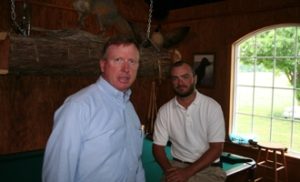
The Guy Darby & Son farm is steeped in history … real and “extravagantly created.”
“My family arrived in Anne Arundel County, MD, in 1654 from Ireland,” says Rusty Darby, the son. “Because of the Revolutionary War, they moved to Chester, SC, in 1776. I think my great-great-great grandfather, Asa Darby, came with Light Horse Harry Lee.”
Henry “Light Horse Harry” Lee served as a cavalry officer in the Continental Army during the Revolutionary War. He was also the father of Confederate General Robert E. Lee.
“The name ‘Derby’ was changed to ‘Darby’ before my family arrived in America. I have a will from 1848 and it’s spelled ‘Darby,’” he says.
The will lists how much cotton each child would receive, and at what price. At that time cotton was 5½ cents-per-pound.
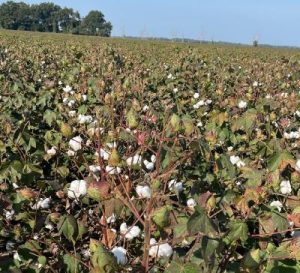
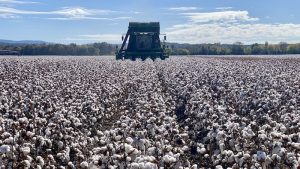
Except for years during the War Between the States, the land the Darbys farm has been in continuous cotton since they arrived in Chester County. “My great granddaddy left to go fight the Yankees,” Darby explains. “There was no one here to ramrod it. He arrived in Charleston two weeks before the Confederates fired on Fort Sumter, and was at Appomattox when Lee surrendered. So I guess you could say he fought in the War Between the States from beginning to end.”
The Darbys’ farm was also used for the “extravagantly created” final battle scenes in the movie “The Patriot.” The scenes are based on the Battle of Cowpens. The actual Cowpens site is near Chesnee, SC – about 60 miles to the northwest. It took place on January 17, 1781, and was a decisive victory by American forces. Nine months later, British General Lord Cornwallis was surrounded in Yorktown, PA, and surrendered to the American and French forces.
Cotton, Cotton
and More Cotton
Darby left the farm to attend Clemson University, then returned in 1978 after a receiving a degree in Agricultural Mechanization and Business.
Anna, the fourth and last of Darby’s and his wife Cindy’s daughters, graduated from Clemson this spring. The other three – Laure Lea, Katie and Julia – are also Clemson graduates. Julia is engaged to Reed Rogers, who has joined the Darbys’ operation, and he, too, graduated from Clemson.
“We’re hardnosed cotton farmers,” Darby says. “There’s just nothing better for this area than cotton – it’s the best option we have. I don’t mean not having other options is a negative – it’s a good option.”
The Darbys also grow fescue, Sericea lespedeza, brown top millet and wheat. All of the fescue, lespedeza and millet is grown for seed. They also have a cow/calf operation.
About 20 years ago, Darby decided it was time to rethink soybeans and brought millet into the mix. “I write down daily rainfall and started overlaying that with our soybean yields,” he says. “I realized that the time of year that soybeans needed rain, we didn’t get it.
“And Daddy says the last corn we grew fed a mule.”
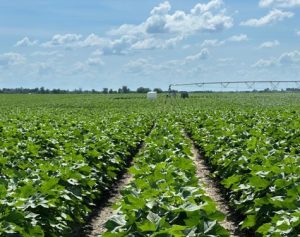
Darby rotates cotton with wheat and brown top millet and has gone to no-till. “The only time I break ground is to plant wheat,” he says. “Rotation is dictated by weed control. If we start to have a ryegrass problem in wheat, I can control it culturally by rotating with cotton. I’m not saying wheat dictates rotation – cotton has priority – but it’s an influence on where I plant cotton.”
For the most part, Darby has been able to avoid the herbicide-resistance scourge that has plagued much of the Southeast, especially Georgia.
“We haven’t developed any resistance yet, except for maybe in one field,” he says. “I’ve tried to incorporate different chemistries all along, and maybe that’s why we haven’t had it. I’ve always used a yellow herbicide – a dinitroaniline – one way or another, and I always use Cotoran.”
Increasing Production
Exponentially
Darby has GPS units on his planters, which allows him to accurately drop back in on old beds. And he uses site-specific fertilizer applications.
“When the price of fertilizer ran up a couple of years ago, we had to find a way to cut costs, and variable-rate applications allow us to do that,” he says.
And he plants several different varieties – Stoneville ST 4427B2RF, PhytoGen PHY 375 WRF, FiberMax FM 1740B2RF and Deltapine’s DP 0912 B2RF and DP 161 B2RF – because he says, “I want to support research. If a company is working to help us do better, I want to buy their products.”
The new technologies, germplasm and traits have improved to the point where Darby says productivity is “phenomenal.”
“Our productivity – the tonnage that leaves here – has changed so much. The amount of product that leaves here is not increasing on an arithmetic curve, it’s increasing on an exponential curve,” he says. “I’m not saying we’re productive more-so than any other farm, but we’re doing so much now per man-hour that it’s just phenomenal to me.
“What I’m looking for is a way to make us more productive in every way possible. We’ve got the same labor, but we’re covering more acres. We haven’t decreased our man-power, but we’ve increased our requirement per man and we are blessed with some great people.”
Marketing and Mills
Darby markets through Carolinas Cotton Growers Cooperative which was founded in 1922, making it the second oldest cotton cooperative in the country.
“I’m in seasonal pools because Carolinas Cotton Growers has professionals,” he says. “We want our average price to be in the top 30%, and I think we’ve done that without a lot of risk.
“There are times when I’m frustrated and think I can do better, but then I tell Daddy that I probably wouldn’t have. I thought when I got out of Clemson that I was going to revolutionize cotton merchandizing.”
And Darby says he’s frustrated, as well, when he sees the United States’ technologies appearing in competing countries. “We’re quicker to give away technology agriculture than in any other industry,” he explains.
He points to the demise of the U.S. cotton-mill industry as a prime example of jobs moving out of the country: “There was a time when we had 10 cotton mills in Chester County alone. They weren’t that big, but had a lot of people working there. There were 32,000 acres of cotton in Chester County back then – in the 40s and early 50s – and there are 3,500 now. There was a thriving vertical cotton industry in this area.”
Still, Darby says, “I’ve never had another job, and I really love cotton.”


Leave a Reply