

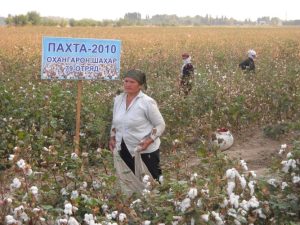
Citing alleged use of child labor in Uzbekistan’s cotton fields, prominent Western textile manufacturers and the European Union are imposing sanctions on Uzbek cotton, but any lasting impact of the moves on the former Soviet nation’s economy is still unclear.
Swedish retailer H&M, as well as such sportswear giants as Adidas and Puma, are among the companies that are boycotting Uzbek cotton, while the EU announced it would end preferential tax treatment on Uzbek cotton imports.
Uzbekistan’s government denied the sanctions would seriously harm the country’s economy, as Russia and other buyers in the Middle East and Asia would remain major trading partners. At the same time, it alleged that “dishonest competitors” were possibly behind the accusations that its cotton industry – the world’s sixth-largest by volume – was using child labor.
“Cotton is also grown in India, Australia, Africa, North and South America, and as far as we know, in some of these countries children are also involved with work in the cotton fields. However, there was not any reaction to this from the human rights organizations,” an official government representative said, adding: “The Uzbek government has also not ruled out the possibility that the hysteria around Uzbek cotton was raised by some dishonest competitors.
“A significant part of our cotton is resold by brokers on the EU and Arab cotton exchanges. In this regard, we do not think that our economy will be significantly affected by the boycott,” the representative said.
Who Will Pay the Price?
It is not Uzbekistan, but the Western companies that will be negatively affected by the boycott, because they will be forced to buy cotton at higher prices while Uzbekistan’s cotton industry will shift to alternative markets, according to the government: “Russia has always been a major importer of our cotton, while among the other major sale destinations are Pakistan, South Korea and the United Arab Emirates.”
“Being a major consumer of cotton, we – like many other companies – take an unambiguous stand against child labor, regardless of the country,” said Henrik Lampa, H&M’s manager of the department of social responsibility.
According to analysts of KirTag, one of Central Asia’s leading business papers, the boycott of Uzbek cotton will negatively affect the EU and protesting companies themselves, which will be forced to buy cotton on the world market at significantly higher prices.
A significant boost in domestic cotton processing is still expected in Uzbekistan in the near future. Local enterprises currently process about 30% of cotton annually harvested in the country, but during the next several years, this figure is expected to rise to as much as 70%. More than 55 investment projects worth $1.7 billion are in the works for the Uzbek cotton and textile industry during the next several years.
Uzbekistan is the world’s third-largest exporter of cotton, and traditionally counts China, Bangladesh, Korea and Russia among its chief trading partners. The Uzbek cotton industry produces about 1.1 million tons of cotton fiber and harvests 3.5 million tons of raw cotton annually.
At the recent 7th International Cotton and Textile Fair in Tashkent, the Uzbek government signed contracts with foreign buyers for the sale of 600,000 tons of cotton.
Historically, cotton production is a major source of income for the Uzbek economy, but the industry has also frequently been the target of serious environmental and political allegations that have triggered protests from the international community and Uzbekistan’s Western trade partners. The Uzbek cotton growing industry has been accused of violating environmental standards, including wasting critical water resources that have drained the Aral Sea.



Leave a Reply