

What seasons of extremes 2005 and 2006 were.
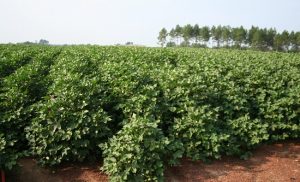
After drowning in the monsoon-like rains of Hurricanes Katrina and Rita in 2005, some of the Mid-South cotton crop died of thirst in 2006.
Take for example field days. The Delta Research and Extension Field Day at Stoneville, MS, was held inside – repeat: a field day held inside – so attendees would not have endure the sledgehammer +100-degree July temperatures. The humidity would have made it even more brutal. (If you are scoring at home, would the chill factor have been 110 degrees?) In 2005, there was a seed-company field day near Stoneville also held inside. But this time it was because nine inches of rain from Hurricane Rita made turn roads impassible. Locks of cotton looked like wet mops.
In Texas, 2005’s crop was so enormous that it took the logistics of handling it to new levels … levels never even imagined. And see that thirst thing again for 2006 in parts of Texas, particularly the High Plains.
Meanwhile, the Southeast was somewhat spared those extremes in both 2005 and 2006.
The Far West continued to be what it always is – a greenhouse with near 100% irrigation.
In July, Somerville, TN, grower Willie German described his crop as a 9 on a scale of 1-10, with 10 being the best. In early September, he was concerned that the drought had turned that into … well, far less than a 9.
“We missed some rains here in August,” German says.
But he wound up pleasantly surprised with his crop: “On some of our hill cotton, we were hoping for 600 pounds and actually made 750. In the bottoms, we thought surely they would not be as good as they have been. Some of our creek-bottom ground picked 1,280 pounds.”
If you are keeping score at home, that’s 2.67 bales per acre in the bottoms, non-irrigated.
Tennessee’s yields will be up 66 pounds over the 5-year average of 811 pounds per acre. “North of me,” says German, “they probably had the best yields they’ve ever had.”
Dr. Ed Barnes with Cotton Incorporated in Raleigh, NC, shared that same pleasant surprise for the Southeast cotton crop. “There was a time when we thought the crop was not going to be very good as a whole,” he says. “What I am hearing is that a lot of farmers are going to end up better than they thought in parts of the Southeast. They are pretty happy, considering the way they thought things were going to turn out. My feeling is that this is going to be near or above average.”
And again as of the USDA November crop report, the Southeast across the board was only down 24 pounds from the 5-year average of 709 pounds per acre. But there were parts of Georgia and Alabama that did take a hit this year: Georgia yields for 2006 are projected to fall 6.5% from the 5-year average, with Alabama down 23%.
On the High Plains in the 2005 crop-year, Glasscock County Co-op Gin near Garden City, TX, ginned nearly 156,000 bales, turning out an amazing 1,000 bales or more per day for 100 straight days. That is evidence that the ’05 crop was more than just a simple record-breaker – it went off the charts.
Texas’ November forecast of 651 pounds per acre is actually up 56 pounds over the 5-year average, but that will not be the case for the High Plains. B. J. Havlak of the Glascock County Co-op Gin says they will gin 40,000-45,000 bales. And again if you are scoring at home, that’s down two-thirds from 2005. For the state, Texas is projected to harvest 5.7 millions bales this year, down from an amazing 8.44 million bales in 2005. And to compound that, there were 6.4 million acres in 2006, compared to 5.950 million in 2005.
“The irrigated cotton … is pretty good,” says Havlak. “Nature did not give us any rain, so the dryland was a disaster. We just didn’t get the rain when it was critical; we received most of it in late August and early September.” Which would have been beneficial only to late-planted dryland cotton.
And it was those disastrous dryland yields that knocked the gin for a loop. Says Havlak: “Last year we ginned 156,889 bales. The extra bales we made last year came from dryland – we made as good a yield on dryland as we did on irrigated.
“We have some dryland acres this year that are just bare ground – it looks horrible.”
Fuel Costs A Big Factor
Here in Memphis the price of regular gasoline topped $3 per gallon in the weeks post Katrina. As we go to press, regular gasoline here is $2.03-$2.06. The score at home? Down about 32% from the Katrina highs.
Again in July, German said, “The price of fuel has doubled since last year. Every time a trailer truck rolls in here – and that’s about every week – that’s $17,000-$18,000. Per acre, that’s probably added $10.”
Havlak said in August: “The increase in the price of fuel has had a tremendous impact, and in more ways than one.” (See soaring nitrogen fertilizer prices, as one example.) “You have to treat the increase almost like a separate cost because it has had a major impact. It’s something you have to have and it’s approaching unaffordable.”
Despite the drop in fuel prices, the general consensus is that dealers may have a considerable amount of nitrogen fertilizer in inventory bought when the price was high. Some will be able to pass that along; others will not. Extremes, again.
“Even though fuel prices have come down from their highs, that is something we will continue to be plagued by,” Barnes says. “The drop in prices will help in the short term. But in the long term, we have to be prepared for higher prices for both fuel and fertilizer.”
Corn And Soybean Prices Affect Acreage
A corn/cotton rotation has always been a good one. Not only does corn build organic matter, it is very effective in controlling nematodes, and often overlooked is the rotation’s weed-control advantage: Corn herbicides control weeds that cotton herbicides cannot without damaging cotton; cotton herbicides control weeds that corn herbicides cannot without damaging corn.
Our acreage survey, which will be released in detail in January, is reflecting the high prices of soybeans and corn. (In early November, the Chicago Board of Trade prices for December ‘07 corn was around $3.40 per bushel; November ‘07 soybeans were hovering around $7.00.) So the survey says: Some growers will abandon cotton in favor of corn, with some planting 100% of their cotton acreage in corn and soybeans.
Farm Bill Uncertainty
With the Democrats making a clean sweep of the House and Senate in November’s elections, the Farm Bill continues to be a huge question mark.
Republicans said, had they retained power, that there would be no reduction in farm-program spending without equal opportunities in foreign markets. Democrats have hinted that they favor a 2007 Farm Bill which would have very little change in what we have now. But they also say, despite their inclinations to make little or no changes, they favor crafting new farm legislation rather than extending the current legislation.
Are we headed for gridlock, and how do you make plans without knowing where we are headed?
“I am still worried about our farm program,” says German. “I wish we had a program in our hands – signed and sealed – so we could make long-term decisions and plans for our livelihood. It’s a shame farmers don’t have a Farm Bill that they can take to the bank.”




Leave a Reply