



Advanced Textile Wipe Is a Life Saving Product
 October 16, 2025
 Hybrid decontamination, involving dry decontamination material and a functional chemical chemistry component, is a lifesaving product.
Efforts are underway to make this decontamination procedure a standard method for personnel and sensitive equipment decontamination.
On Oct. 14, about 147 participants from fire departments across the country attended a presentation on “Next Generation Decontamination,” by Fredericksburg, VA-based First Line Technology (FLT).
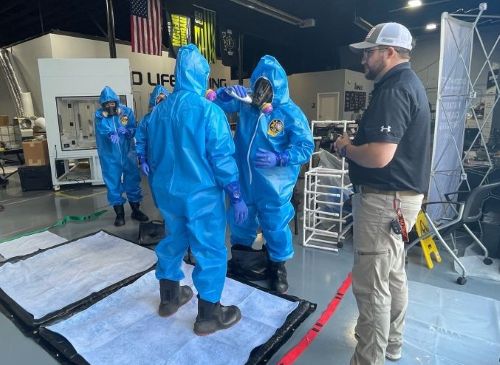
FiberTect use in a training site. (Source: First Line Technology)
The presentation was made by Frank Roberts, a training specialist at First Line Technology, who has served ten years in the United States Marine Corps, beginning his career with the Chemical Biological Incident Response Force (CBIRF).



Tracing back to the history of personnel protection and decontamination since World War I, Roberts recorded the developments that have taken place since the Gulf War in 1990/91, which is considered as the era of modern decontamination.
The past decade (2015-present time) has resulted in a leap in research, development and deployment of modern personnel and military decontamination products and methods, particularly moving away from corrosive chemicals and extensive water-based methods.
The hybrid decontamination method is being promoted as a standard for decontaminating personnel and sensitive equipment by First Line Technology, stated Frank Roberts.
Personnel belonging to defense and civil protection agencies such as those from Chicago and South Dakota explained how the use of FiberTect, a nonwoven textile technology developed at Texas Tech University, is effective as a dry agent. Particularly, in regions where sub-zero temperatures are common, water-based decon solutions are not effective.
“Dry decon in cold weather climate minimizes water-based technologies,” stated one civil defense personnel who was endorsing the application of dry wipe for decontamination. A participant from Canada also advised about its effectiveness as a dry agent.
Hybrid decontamination is a three-step process, which involves:
- Blot: Remove excessive toxins using FiberTect dry wipe
- Apply: Apply chemical formulations to neutralize agent
- Remove: Wipe away leftover toxins and neutralized particles.
Depending on the type of application, FiberTect is a flexible platform technology that allows the use of synthetic or cotton-based absorbent layers with the active core being high surface area carbon. The structure and ease of use are technology-based advantages the dry wipe offers to the end users.
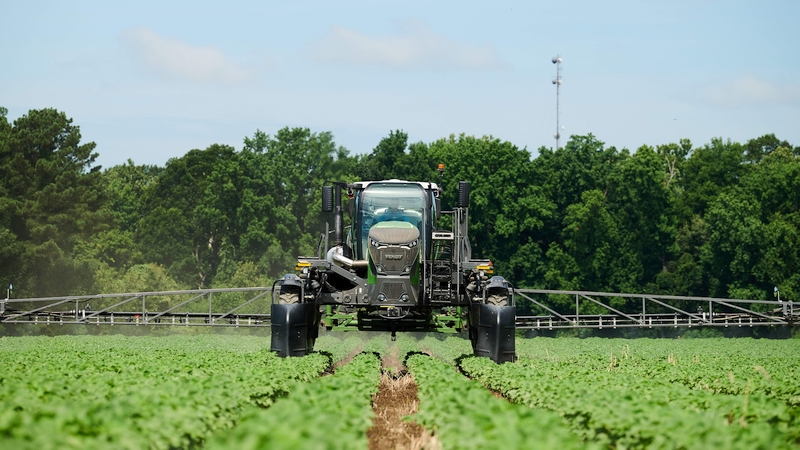
The next phase of decontamination will be green technology based, allowing alternative materials such as cotton to be explored.
Modern decon will be faster, flexible, and efficient, stated Roberts. Artificial intelligence may play a role in threat prediction and modeling. Drones will be employed for decon applications, reducing the need for human intervention, he added.
While the dry wipe was invented for toxic chemical decontamination, the high surface area adsorptive core enables the wiping away of fine particles like Fentanyl, stated Roberts. The United States Army recently evaluated the effectiveness of FiberTect along with other products, and the results are now in the public domain.
FiberTect is a patented technology, which was evaluated by Department of Energy’s Lawrence Livermore National Laboratory for mustard gas decontamination and recently by the U.S. Army for fine particulate adsorption. The results on mustard gas were peer-reviewed and published in an American Chemical Society’s scientific journal. An important feature is that due to the unique and robust structure, the wipe does not off gas volatile compounds like mustard gas.
The hybrid decontamination method highlights University/Industry collaboration with industry translating academic laboratory research into a commercial lifesaving product, enabling it to be a defense industry standard.
Collaboration leads to improvement in decontamination techniques, stated Roberts.
The next phase of this field is all about “Speed, Safety and Simplicity.”
GET THE NEWSLETTER TODAY!