

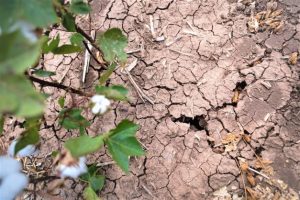
Located a short half-hour drive inland from Corpus Christi, the tiny town of Driscoll, TX, didn’t see much rain for most of the 2025 production season. It was so dry in the early spring that farmers here worried they may not be able to plant a cotton crop at all.
But for seasoned producer Larry McNair, those challenges were nothing new. As he patiently waited for spring rains, he leaned on the wisdom he’s gleaned in 43 years of cotton production. What gives him even more confidence — some of the farmland in his operation has been in his family’s hands for a century.
Larry’s great-grandfather, John McNair, moved into the area in 1925 and soon began farming a one-section block of land with his three sons.
“That same land that they moved on to back in 1925 — we’re still farming it today,” says Larry. “We’ve acquired some more land, of course, since that time. But we’re still farming that original block of acreage.”
In the century since that first block of acreage went into production, the McNairs have had the opportunity to grow their operation considerably. Luckily for Larry, he has a new generation willing and able to farm the land with him. His son, Lincoln McNair, daughter, Lindey Sappington, and son-in-law, Jessie Sappington, are now looking over the operation, as well. All were forced to wait through droughty conditions earlier this season.
In a typical year here in South Texas, the McNair family likes to plant grain sorghum in February and then get their cotton crop planted in early March. But as dry conditions lingered into the planting window, some doubt crept in.
“We were so dry at planting time,” says Lincoln McNair. “We just didn’t feel good about the cotton, so we didn’t plant it. We just got the land ready.
“And then on March 28 we got good rain, so we went in and planted right after that. We’ve had to make this cotton crop right in the middle of a drought.”
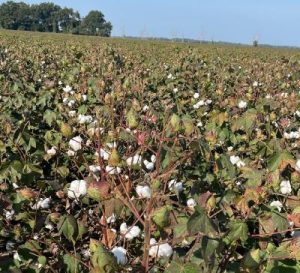
All of the McNair family’s acreage is in dryland production here in the Coastal Bend. Larry jokes that the fickle nature of rain here has his family doing rain dances “all year long.” They must’ve paid off in 2025, as the brief windows of rain came at timely moments in the season. Ultimately, the family’s 100th crop delivered some impressive yields — right in the middle of that drought.
Across Generations
Larry has farmed here “all his life” but says he officially started farming back in 1982. At that time, he was working with his own father, Melvin McNair, and his brother Donny McNair.
Prior to that, he says, he was fortunate to have worked with his grandfather — meaning Larry has personally worked with four generations of his family on the same farming operation.
“That’s the one thing about cotton farming and farming in general,” Larry says, “is the whole family atmosphere that comes with it. The whole family history is tied to the farm.”
Larry stresses that family support is what has kept the farm successful over the past century.
In total, there have been five generations of McNair’s who have worked on the family’s farming operation — although a sixth could soon be on the way. Larry’s grandson, Ben, is now studying agronomy at Texas A&M Kingsville, and he may have an interest in joining the operation once he finishes his schooling.
“It’s never been a one-man operation,” Larry says. “I’ve always been in partnership with family, and it’s always been ‘We,’ and never just ‘Me.’”
For now, it’s a three-man partnership between Larry, Lincoln and Jessie. Each man has his own role to play on the farm. Jesse handles equipment needs as well as labor management (about seven employees on-hand during the production year). Lincoln generally handles the business side of the operation. And all three men collaborate when it comes time to market their crop.
For his part, Larry bristles at the notion that he’ll be retiring soon, although he acknowledges he’s been intentionally slowing down a little in recent years. All three men have a good laugh about the prospect.
“Is (Larry) not moving fast enough for you, these days, Lincoln?” Jessie jokes.
“We like having Larry around, no doubt about it,” Jesays, in a straight voice. “Just maybe not as much as his wife likes having him around!”
Cropping Mix
In a typical year, the McNair operation with some rotation of milo and cotton. That’s out of necessity, they say.
“Soybeans don’t work here. Corn will only work if it rains at exactly the right time,” says Larry. “So, milo and cotton have been the mainstay here as long as I can remember.”
Unfortunately, prices for both crops have been depressed for much of 2025. But the men are hopeful that commodities will rebound in the coming year.
The McNair’s were able to offset some of those lagging commodity prices by finding strong yields despite challenging growing conditions in 2025. For that, the family credits their Deltapine and Dekalb varieties.
“We’ve planted Deltapine as long as I can remember,” says Larry. “There’s been times when the varieties have gotten stronger — but the Deltapine varieties are very, very good for this area right now.”
For the 2025 season, the McNair operation relied on DP 2020 B3XF and DP 2012 B3XF — and Larry notes they both yielded very well. He also notes, that it is a necessity these days. If there’s one thing he’s seen change in his 43 years of farming, it’s the cost and the margins that go into producing a cotton crop.
“The break-even price has gone up considerably,” Larry says. “And yields have had to go up considerably with it, and they have. It has to do with the technology coming from the cotton varieties, the chemical technologies, the equipment technologies, the fertilization — all those things together.
“We can make a lot more cotton than we used to be able to make — that’s been one of the biggest changes is the capabilities of production.”
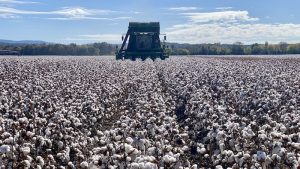
On the same ground where one bale per acre used to be the norm, the McNair’s now shoot for 3 bale per acre. “We don’t always hit it, but that’s about what we did this year.”
Not too bad for a crop grown “in the middle of a drought.”


Leave a Reply