



High Plains Could Be Cotton Central This Year
 February 12, 2009
 It appears that 2008 cotton acres will continue to drop in virtually every region of the Cotton Belt, thanks to strong prices for corn, grain sorghum, wheat and soybeans.
Having already seen significant shifts away from cotton in 2007, additional acreage shifts in 2008 will amount to a significant consolidation of U.S. cotton acres in the central portion of the country — namely Texas.
The reasons for this are many, but perhaps the most important factor preventing the further consolidation of cotton acreage in Texas generally, and the Texas High Plains specifically, is the weather.
Planting decisions by growers in other parts of the country often hinge solely on the price differences between cotton and other crops.
On the High Plains of Texas, the semi-arid environment limits our cropping options to those that best fit this region’s typical rainfall patterns. We often joke that if you listed a High Plains farmer’s three best crop options the list usually reads cotton first, second, and usually third, on a majority of the area’s acres.

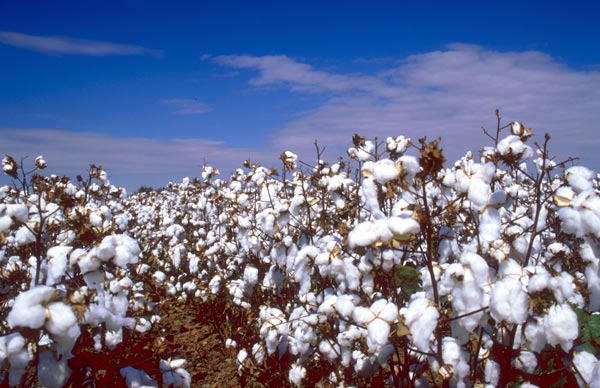
It’s all about the water (and the price)!
Heading into the 2007 growing season, we expected that some cotton acres in our higher capacity irrigated areas would switch to corn or grain sorghum, due to a combination of high prices and a promising early season moisture situation that growers hoped would take the strain off of irrigation expenses later in the growing season.
An even better early season moisture situation at planting time eventually turned what we estimated would be a 350,000-400,000 acre shift into the significant movement of 687,000 acres out of cotton last year. This was about what many believe is near the upper limit of the acres that have the capability, irrigation-wise, to support a thirsty corn crop with normal rainfall during the growing season.
Even though we have a much different moisture outlook at the present time, it appears that growers who made the switch to grain last year aren’t quite ready to commit to a move back to cotton just yet.
The reason for their hesitation is simple. There is still plenty of time for the moisture situation to improve heading into planting season and corn, wheat and grain sorghum prices continue to dwell in the upper reaches of the market atmosphere.
Further complicating their decisions is that the cotton market seems to have finally managed an upward trend of its own in recent weeks, thanks to projections for reduced 2008 production and carryover stocks.
It all makes a High Plains cotton farmer’s decision to shift additional acreage away from cotton, or to shift back to cotton on some farms, an increasingly harder one to make.
Even with the near perfect moisture and market situation that existed last season, the High Plains still planted 3.19 million acres of cotton, easily keeping it the dominant row-crop planted in the area. Texas numbers are also likely to stay relatively stable, and hover near the 4.9 million acre level planted in 2007.
Improving cotton prices and a near-perfect agronomic fit are the top reasons a majority of High Plains growers will resist the temptation to move many more acres to other crops in 2008. Add in the fact that the area has limited grain handling infrastructure, which was “maxed out” by the 2007 crop, and there is a good case to be made that the High Plains has gone about as far as it is likely to go in the near-term.
Another factor impacting cotton acreage is variety selection. Whether it is one of the newer biotechnology enhanced cotton seed varieties, or maybe an older, longer-season conventional variety that has been around for many years, a different set of selection criteria seem to have been adopted by High Plains cotton producers over the last three or four years as they set new expectation levels for both yield and quality.
Largely fueled by the fact that most of the new technology-enhanced varieties don’t have what you would consider an old fashioned “stripper cotton” pedigree, growers have quickly gotten comfortable managing a somewhat different type of cotton.
The end result has been a significant change in varieties and, with mostly favorable weather patterns, record crops that at first seemed to defy explanation.
The explanation is actually pretty straightforward. Less determinate varieties just have the inclination to try and make cotton longer than did the older varieties that dominated the High Plains market before the days of drip and LEPA irrigation, plant growth regulators and harvest-aid programs. Coupling them with modern management techniques has allowed growers to take advantage of the yield and quality upside that these varieties bring to both irrigated and dryland situations.
In dryland situations, these varieties have shown an ability to take advantage of the moisture available to produce good yields, while also demonstrating an ability to go ahead and put on a few late bolls that our older, more determinate varieties would not have been able to set. There is no doubt that these late bolls still need a lot of help to reach full maturity and contribute to the final yield. The fact that these bolls have the opportunity to contribute is what many growers feel gives them a leg up on older varieties that cut-out much earlier when things get dry.
With just over 10 million acres expected to be planted to cotton in 2008, it is no surprise that industry watchers expect between 40%-50% percent of all U.S. cotton acres to be planted in the Lone Star State in 2008.
With over two-thirds of those Texas cotton acres located inside the 41 counties that make up the Texas High Plains, it appears that the Lubbock area could be U.S. Cotton Central in 2008.
One thing I know for sure is that my fellow producers who farm in the biggest cotton patch in the world are more than ready to put their best effort into keeping the region one of the world’s most important cotton production regions in 2008 and beyond.
In both volume and quality, the Texas High Plains can deliver the fiber our textile customers demand.
No matter how you slice, it the Texas High Plains is cotton country.
Caption (photo):
Steve Verett
Add 3 Charts:
High Plains Harvested Acreage (in millions of acres)
High Plains Yield (in pounds per acre)
High Plains Production (in millions of bales)
GET THE NEWSLETTER TODAY!