



Starbucks is Living Proof China Arrives in the 21st Century
 March 3, 2009
 There may not be one on every street corner — a la Manhattan — but when a country has a Starbucks, it has arrived in the 21st Century.
Think back to 1971, when the first Starbucks opened at Pike Place Market in Seattle. Now think back to the 1989 Teineman Square riots in China. Asia Times Online says there are now “400 stores in China, including 180 on the mainland.”
These days, Starbucks has more than 12,000 coffee shops in more than 35 countries. And also these days, China is the beast of global cotton. China produces 30 million bales of cotton annually, consumes 50 million bales, and imports 9 million U.S. bales.
It may not be purest definition of harmonic convergence, but it’s a true picture.
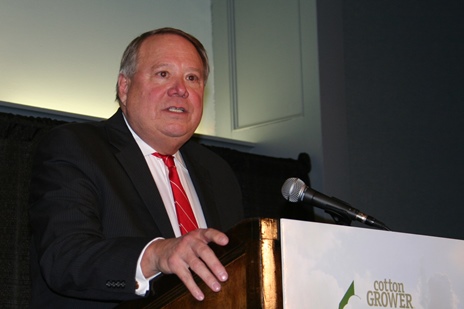
“China only recently opened up its economy to allow some private businesses and it’s causing an unbelievable amount of change,” said John Mitchell, a vice president at Memphis-based Cargill Cotton. His comments came at the Beltwide Cotton Conferences in New Orleans.

“China has adopted some of our Western ways,” Mitchell continued. “And, in 2001 began to reform its cotton industry. The state gave up its monopoly on cotton imports and anything before that was sold to a state agency. But the state still manages the economy through very broad policies and macro-control of exchange rates, credit policies, and particularly through cotton reserves and import/export policies. … It isn’t the exactly a free-market system, but it’s more transparent than we’ve dealt with in the past because we can see what the formula is.”
So the Bamboo Curtain is not completely open, but it’s rising.
NCC, CCA and MOUs
The National Cotton Council (NCC) and the China Cotton Association (CCA) signed a Memorandum of Understanding (MOU) in mid-November in Memphis. And in 2006, NCC sent a delegation to China, which was, “the first time a multi-segmented group (had visited) China,” said John Pucheu, a Tranquility, CA, cotton producer who serves as chairman of the American Cotton Producers. “The purpose of the trip was to gain a better understanding of the market in China and to demonstrate to the Chinese how important we think they are as customers.”
If your image of China is bicycle-riding peasants in Mao jackets over black pajamas, then rethink it. Pucheu had visited China twice before — 9 years ago and 14 years ago. This time around, he said, “I was constantly struck by the improvements across China, Mao jackets have been replaced by western-style apparel. Bicycles were the most common mode of transportation, but you rarely see bikes anymore — the streets are too congested.”
Modern Mills
“When I was there 9 years ago, most mills I saw were state-owned, dirty, and had old equipment,” Pucheu said. “The mills on this trip, in most cases, were far more modern than (American) mills, and they are run by sophisticated entrepreneurs.”
One mill alone is equipped with 100,000 yarn spindles and gobbles up 4-5 million bales per year.
“We saw very few people there,” said Pucheu. “It was computerized, with electronic controls, and it doesn’t require a lot of people to be involved with the operation.”
But back to the 4-5 million bales that particular mill consumes. Think about that for a moment: That equals half of all the cotton the U.S. sells to China.
“If you look at China’s consumption, you can see that most of their increase in consumption is coming from imported cotton,” said Mitchell. “The volume of cotton that we have been selling to China for the last 4 years, and projected for next year, will be (reducing) off-take in the U.S.”
In the U.S., yields are king, but fiber quality has at least become queen as more and more American cotton farmers begin growing for the foreign markets. Between 70%-80% of U.S. production is exported, with American mills consuming just about what that one mill China is consuming.
And that makes marketing American cotton very basic. “The fundamental thing we have to try to do better is focus on our customers’ needs,” said Mitchell, “and not concentrate on what we’re trying to sell.”
GET THE NEWSLETTER TODAY!