



The U.S. Effect
 February 3, 2009
 ICE No. 2 Contract
The events of early March have left the world cotton trade without a viable futures contract for a number of months. We know the affect of what happened, but not the cause. Hopefully, a pending CFTC investigation will shed some light on the trades that occurred early in that first morning of full electronic trading.
Many in the cotton trade lack confidence in the No. 2 Contract given the possibility of large speculative funds driving the price up or down unrelated to market fundamentals. Currently, the cotton market fundamentals are in a doldrum because of the weak demand for our product. The trading of just a few contracts one way or the other can move the market. We must get back to where we were earlier this year, when the contract was a viable instrument for hedging purposes.
In attempting to deal with what many of us feel was excessive speculation, the American Cotton Shipper’s Association (ACSA) has been working with the CFTC and the Congress to impose strict reporting requirements on the unregulated funds and the over-the-counter traders. And, if necessary, once we know the full scope of their activity, to impose speculative position limits similar to those placed on each of you as commercial users of the Number 2 Contract. Our efforts have been successful in the CFTC adopting a number of new reporting requirements by these speculative trading entities.
While ACSA was successful in having legislation passed by the House calling for more transparency through comprehensive reporting requirements, the Senate failed to vote on the measure. We expect the next Congress, in 2009, to enact comprehensive legislation calling for a stricter regulatory regime in overseeing both the exchange traded and off-exchanged traded commodity markets.
ACSA and Amcot have also prevailed on the Intercontinental Exchange (ICE) to make changes in the No. 2

Contract that we viewed as essential to each of your interests. Some key reforms were recommended to and adopted by the ICE:
- The original margin requirement was reduced from $3,500 to $1,800.
- The closing margin for futures was set at the futures price settlement and options at the options price settlement.
- Trading limits will be increased on a gradual basis from 3 to 4 cents when any 2 of the first 5 listed contracts trade at the 3-cent limit with a reversion back to 3-cents when no contract month closes at 4-cents, and 4 to 5 cents under the same conditions, and an additional 1-cent increase when 2 delivery months with the highest open interest settle at 84-cents or higher.
I would add that the ICE proposed there be no trading limits on the cotton futures contract, but ACSA argued that, in the current trading environment, such a proposal was unacceptable.
Doha Trade & Development Round
The World Trade Organization’s “Doha Trade & Development Round” has been ongoing for seven years. Early in the discussions, the U.S. and EU cotton program became the primary targets for reform and were specifically isolated for special treatment pursuant to the WTO’s 2005 Hong Kong accord requiring that:
- All forms of export subsidies for cotton would be eliminated by developed countries.
- Developed countries would give duty-and-quota free access for cotton exports from Least Developed Countries from the start of the implementation period for the agreed reform in agriculture.
- Trade distorting domestic support for cotton production would be reduced “more ambitiously than for whatever agreed general formula to be implemented, and over a shorter period of time than generally applicable.
Lacking an agreement, no action has been taken on cotton. The question remains, will there be an agreement in 2008? In my opinion, no there will not be. Why? The most obvious reason is the recent resignations of Peter Mendelson, the EU’s Chief Trade Negotiator, and Crawford Falconer, the Chairman of the WTO Agriculture Committee. Lacking these key players, the agriculture talks will have to wait until 2009.
There is another important reason the talks will be delayed: the Indians and the Chinese have been reluctant to give on market access. In this regard, I would put more of the blame on the U.S. because of what I consider to be a flawed negotiating strategy. Everyone knows that President George W. Bush wants a deal. In order to get one, the Bush administration has used the naïve tactic of negotiating with itself by continuing to come to the table with proposals for larger and larger cuts in American agricultural programs. The developing countries are wise to this; at each meeting they tell the U.S., “that is not sufficient – you can go further.”
Going into the talks under the previous trade agreement reached in the Uruguay Round, the U.S. was entitled to approximately $45 billion in trade-distorting and non-distorting agricultural subsidies. The trade-distorting portion could not exceed $19.5 billion. In Geneva, the U.S. agreed to take the total of all agricultural subsidies down to $15 billion and expressed a willingness to accept further reductions in return for specific market access proposals. Lacking an accord on reasonable market access, the talks ended.
Should an agreement be reached, the U.S. and EU cotton programs would have to be reduced at a higher rate, probably one-third more than the other agricultural commodities, and within a shorter time span than the other agricultural commodities.
Should the current U.S. efforts to finalize a deal materialize in an agreement in the coming weeks, it is my belief that it would not be acceptable to the U.S. Congress, unless it provided for real market access for both agricultural and non-agricultural products, an unlikely prospect given the stand taken by China and India.
That being the case, in all likelihood, the new U.S. President, Barack Obama will decide the outcome of the Doha Round. With Obama’s win in the November election, you can expect a re-evaluation of the U.S. trade policy resulting in a delay the of Doha discussions. Also, in contrast to John McCain, Obama is a supporter of farm programs.
Farm Bill
The U.S. Congress, in enacting The Food, Conservation & Energy Act of 2008, better known as the Farm Bill, made modest steps towards reform. Though President Bush vetoed or rejected the legislation, the Congress overrode his veto and ignored his statement that: “At a time when net farm income is projected to increase by more than $28 billion in one year, the American taxpayer should not be forced to subsidize that group of farmers who have adjusted gross incomes of up to $1.5 million. When commodity prices are at record highs, it is irresponsible to increase government subsidy rates for 15 crops, subsidize additional crops, and provide payments that further distort markets. Instead of better targeting farm programs, this bill eliminates the existing payment limit on marketing loan subsidies.”
I would term the list of the cotton program provisions as modest reforms. Keep in mind that each of the U.S. states has an agricultural component and each state has two Senators. Therefore, the legislative influence of the farm sector is considerable. While increasing the loan rates and target prices for all other commodities, the Congress made an exception for the Upland cotton program. A significant reform was made in the method utilized to determine the loan premiums and discounts that will have the effect of reducing loan benefits. Storage payments were also reduced by 30% during the life of the program.
Though the payment levels for direct and counter-cyclical payments remain at the same levels, the rules for determining payments were changed to reduce the aggregate amount of payments that a producer can receive. The Adjusted Gross Income test to determine payment eligibility was also substantially reduced from $2.5 million to $750,000 USD. In what is considered a potential budget blunder, relying on USDA and Congressional Budget Office (CBO) analysis that prices would remain above the loan level for the life of the Farm Bill, the Congress eliminated the marketing loan gain limitation of $75,000. Since then, the market situation has changed dramatically. Though our production is down, we have the highest carryover in 40-years, and world demand is stagnant given current economic conditions. We could see marketing loan payments in the coming weeks.
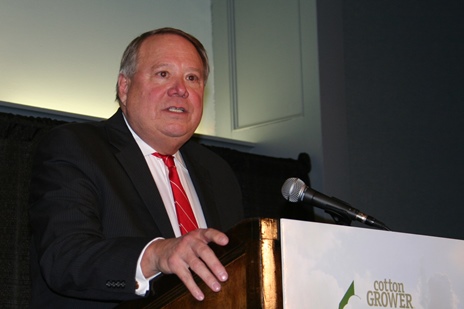
Note: Mr. Gillen presented this report on U.S. subjects of interest and concern at the Association Française Cotonnière (AFCOT) Annual meeting in Deauville, France.
Caption (photo):
Neal P. Gillen
GET THE NEWSLETTER TODAY!