



Cotton Management Strategies When Tropical Weather Approaches
This is our least favorite subject to write about. Hopefully, this is a wasted effort. Regardless, there remains quite a bit of uncertainty regarding the likely path of Humberto, and more so for the yet-to-form Imelda which is only a short distance offshore.
Models have changed quite a bit just today. The lack of uncertainty, and little notices, leaves us scratching our heads regarding what we should do. Your own personal risk tolerance should influence your decisions, but below are some of our general recommendations for potential landfall of tropical weather.
Most areas remain dry, although forecasts look more favorable for rain this weekend and early next week. As expected, the recent dry weather in most places has noticeably accelerated boll opening and most unopened bolls are fairly mature, meaning that they will also likely open relatively quickly unless rains and cool weather slow them down.
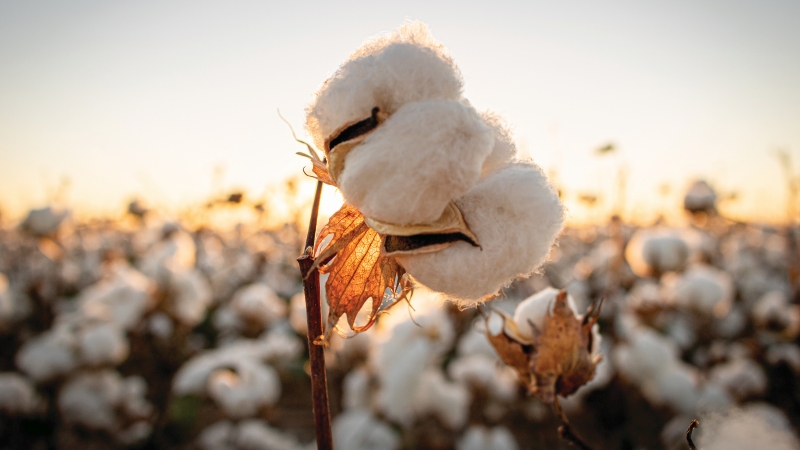
We’ve said this more times that we can count — if a tropical storm makes landfall in North Carolina, open bolls are vulnerable and closed bolls are protected for the time being. If you have several unopened bolls remaining, DO NOT defoliate in the days leading up to a storm. Most growers are usually concerned about losing time due to saturated ground following a storm. There is no point in being on time when there isn’t much left to harvest.
Once there is some degree of certainty that tropical weather is likely, it is best to pause defoliation until it passes. If the storm misses us — and hopefully it does — then we may lose a few working days at worst. If a storm hits us AND there are a meaningful number of closed harvestable bolls remaining, those bolls will be protected for the most part. A slightly cracked boll will likely hardlock and a fully opened boll will likely be lost to weathering.

Below is a fraction of data from a recent research project that our Master’s student, Jeremy Hendricks, recently completed:
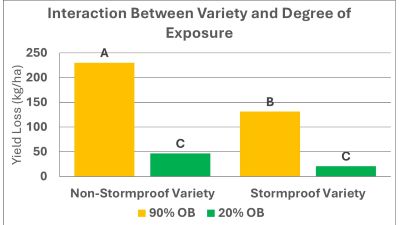
This data illustrates both the value of a stormproof variety, which is less likely to lose as much yield during high winds/rain, and the risk of loss due to high exposure (more bolls opened). Obviously, we can’t change varieties at this point, but there is value in stormproofness when tropical events occur, so this is something to consider.
Conversely, varieties with a high degree of stormproofness may also be more at risk of hardlocking in years when prolonged wet weather occurs while bolls are opening. There is a tradeoff, but stormproofness, as well as spreading out planting dates, are both ways to mitigate some risks in the Fall.
The chart also illustrates risks of yield loss due to increased exposure (higher proportion of bolls opened when tropical wind/rain occurs). Although the stormproof variety lost less yield than a non-stormproof variety, both varieties lost substantially more yield when more bolls were opened during tropical conditions. This is the one factor we can control at this point.
Again, if you have a meaningful number of closed bolls remaining in the field, DO NOT defoliate until these storms pass. We are not behind schedule yet, so risking a few potential lost days of fieldwork is a minor concern right now. The greater concern is the risk of losing noticeably more yield if we defoliate now or for a few more days leading up to a potential tropical weather event.
If you have already defoliated and nearly all bolls are open, try to harvest it (if weather allows) before any potential storm arrives.
GET THE NEWSLETTER TODAY!