




Late-season Pests Likely in 2021
Insects are moving into cotton from mature crops
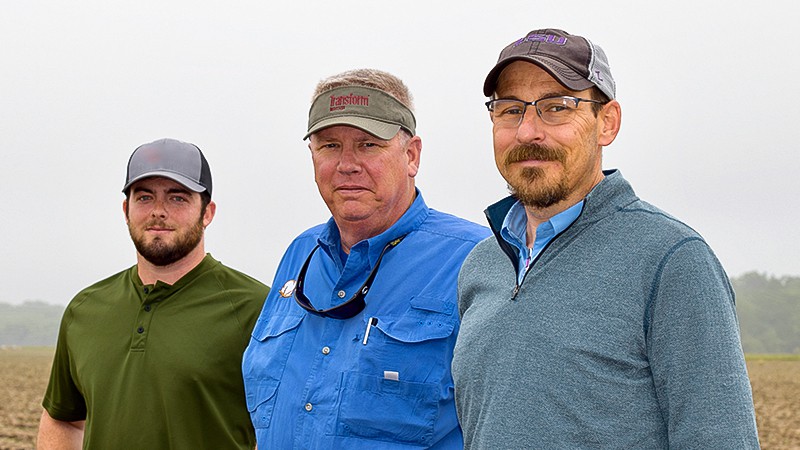
Tarnished plant bug control is top of mind for crop consultants Nate Jennings, Richard Griffing and Ashley Peters
This is not the year to take a wait-and-see approach to insect control. Increased corn and soybean acres, combined with later-planted cotton, are setting up ideal conditions for increased cotton pest pressure.
“If you get rained out for four days and tarnished plant bug populations get a footing, you can lose control. You’ve got to spray often to keep them down,” says Richard Griffing, cotton consultant in Monterey, Louisiana.
With cotton acreage down over historic levels and corn and soybean prices at more profitable levels than in recent years, the 2021 Mid-South landscape looks a bit like the Midwest.
“Most of the corn in northeast Louisiana got planted as intended during our ideal planting window, but cool spring temperatures and rains delayed cotton and soybean planting anywhere from two weeks to a month,” says Steve Crawford, contract consultant for Corteva Agriscience.
June flooding throughout much of the Mid-South Delta further delayed crop maturity, with many growers attempting to replant crops in late June and into July.
That means that when corn is being harvested and early planted soybeans are maturing, nearby cotton will be especially susceptible to damage from insects migrating to greener fields.
As a result, Louisiana cotton consultants are preparing for heavy tarnished plant bug pressure and a late-season flush of worms and other pests.
Northeast Louisiana cotton farmers average six sprays per season for tarnished plant bug control. Being located near river levees and an increase in CRP and WRP acreage has increased the number of available plant bug hosts. This year, that number could be even higher for some growers.
We’ve got corn everywhere, and I’m afraid tarnished plant bug pressure is going to be terrible this year,” Griffing says. “The cold, wet weather that stretched into May also likely killed a lot of beneficials, which may further increase pest pressure.”
Griffing and fellow consultant Ashley Peters of Winnsboro, Louisiana, agree that this is a year to target tarnished plant bug early and often.
“As late as we are going to be, you don’t want to hesitate on insect control,” Peters says. “The way this year is going, you’ve got to take advantage of every window of opportunity to make applications by mixing three to four crop protection products together in the same trip across the field.”
Both Griffing and Peters generally recommend a 1.5 ounce per acre rate of Transform® WG insecticide for the early season back-to-back treatments. They increase the rate to 2.0 ounces per acre for additional applications as needed.
Rate recommendations are based on whether or not there are adjacent fields of mature corn or a recently harvested early soybean crop, as well as the time of year and residual activity needed.
“With our planting delays this year, we’ll push it hard and be aggressive, Griffing says. “Beginning at match-head square, we’ll hit them with back-to-back applications of Transform, and then switch off to a Bidrin or Diamond tank mix, then another tank mix and then Transform again if needed. If tarnished plant bug pressure gets bad enough, we’ll treat with a Transform plus Diamond tank mix.”
The goal, they say, is to limit pyrethroids because of resistance development and potential flaring of secondary pests. However, if an additional late-season insecticide application is needed, Peters suggests a tank mix of acephate and bifenthrin. “It works well because it’s all you’ve got left,” he says.
Every application of Transform also will include mepiquat chloride to slow plant growth, Griffing says. “If you haven’t accomplished plant growth regulation between match-head square and bloom, you are going to lose control in these fertile soils planted with powerful varieties.”
Learn how Transform can put a stop to tarnished plant bug infestations in your cotton.
TM ® Trademarks of Corteva Agriscience and its affiliated companies. Isoclast is a registered active ingredient. Transform WG is not registered for sale or use in all states. Contact your state pesticide regulatory agency to determine if a product is registered for sale or use in your state. Always read and follow label directions. © 2021 Corteva. CA14-396-032 (07/21) BR CAAG1TFRM053