




Nematodes wreak havoc on cotton yields. Fight back without extra input costs.
Nematodes are silent yield-robbers, often overlooked and misdiagnosed as a fertility issue or symptom of drought. For many growers, nematodes are “out of sight, out of mind.”
If your cotton yields have been stagnant in recent years, nematodes could be the problem. With PhytoGen® cottonseed, there’s a solution that doesn’t require costly crop protection applications.
Most PhytoGen® brand varieties are resistant to both root-knot (RKN) and reniform (REN) nematodes while also providing high yield potential. Research from Mississippi State University suggests that planting a PhytoGen® W3FE variety with resistance to both REN and RKN can increase cotton yields by 175 pounds/A up to 502 pounds/A, compared to varieties without both nematode traits. The MSU trial was conducted from 2022 to 2024 in a field with REN populations that exceeded thresholds.1
Not only did cotton yields increase with PhytoGen brand varieties, but REN populations were 79 percent lower following the PhytoGen brand variety with REN and RKN resistance: 687 REN/pint of soil compared to 3,289 REN/pint of soil with the competitive variety. Lower nematode populations at the end of season also provided an edge the next year.
In the second season, soybeans following the PhytoGen brand variety yielded 8 bu/A more – or 16% greater – than soybeans following cotton varieties without REN and RKN resistance. The research results suggest an opportunity for producers to increase yields in both crops by reducing overall nematode populations through PhytoGen brand varieties with REN and RKN resistance.
Jonathan Siebert, Ph.D., Corteva Agriscience Agronomy Lead – South Delta and Southwest, says the MSU research confirms what he’s seen in trials and on farms.
“Reniform nematodes are an often-overlooked pest that can negatively impact yield in both cotton and soybeans,” Siebert said. “By planting PhytoGen brand varieties with reniform and root-knot nematode resistance, growers can reduce nematode populations in the field, increase cotton yields, and improve soybean production the following season.”
While Siebert believes an integrated pest management approach is always the best practice, he says the MSU research demonstrates that REN and RKN management in cotton, as well as in a cotton-soybean rotation, begins with planting a resistant cotton variety.
“Our highest yielding varieties come with resistance to reniform and root-knot nematodes, so you don’t have to choose between top-yielding varieties and nematode resistance – you get both with PhytoGen,” Siebert said. “And if you have reniform nematodes and want to increase soybean yields, there’s no seed treatment or chemical control measure that will reduce field populations like planting reniform-resistant PhytoGen brand varieties the previous season. If you can increase soybean yields by 8 bu/A, you’re basically paying for your soybean seed. That’s a game changer.”
The Proof is in the Field
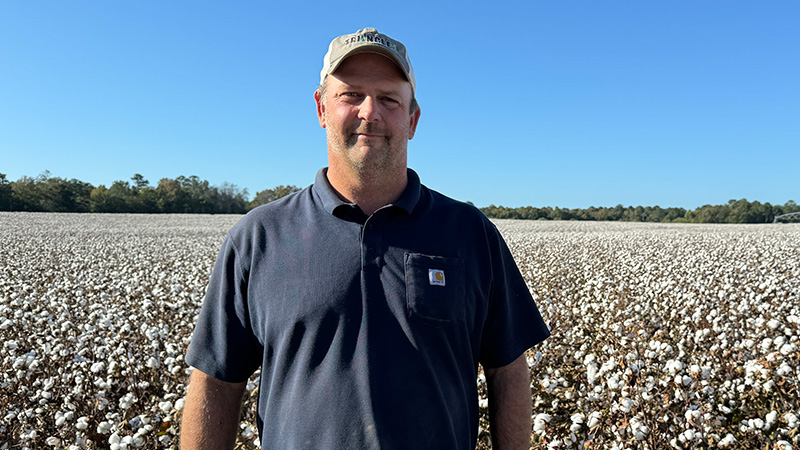
Georgia cotton producer Chris Hill says PhytoGen brand varieties with nematode resistance have helped him significantly produce higher yields with lower crop protection costs for better overall profitability.
Hill tried many crop protection solutions through the years, including soil fumigants and aldicarb. Those products raised input costs by nearly $100 an acre and required extra trips across the field.
In 2023, he planted PhytoGen brand varieties, and the proof came after harvest: PhytoGen® brand PHY 411 W3FE yielded 1,600 pounds/A — without any nematicide treatments.
“That’s better than we could yield with the competitive varieties plus nematicides, and I saved $100 an acre on crop protection,” Hill said. “We’re making more money with PhytoGen. That’s the bottom line.”
Hill produced higher yields in 2024, and the 2025 season proved more of the same, even in the face of serious challenges. Hill experienced a drought the entire month of July, during a critical time for boll and fruit development. Despite that, his PhytoGen brand varieties pushed through and produced a record-breaking crop for the third year in a row.
“We set yield records across the board in 2025, and it really wasn’t a great year weather wise. We didn’t get a drop of rain in July,” Hill said. “PHY 475 W3FE yielded 1,860 pounds per acre on a field that yielded 1,200 pounds the year before and even less the year before that. We’re lowering our nematode populations each year by planting PhytoGen varieties, and the yields keep improving.”
Hill says PhytoGen brand varieties require less irrigation and look less drought stressed during the season. He attributes that to the in-plant nematode resistance, which protects roots for fuller, healthier root systems that can better uptake water.
“Without a doubt, the water requirements are less with PhytoGen varieties. We don’t have to water as much, and we’re conservative with our irrigation,” Hill said. “PhytoGen varieties hold up under dry conditions better than anything else we’ve ever planted.”
To learn more about PhytoGen brand varieties, go to PhytoGen.com/varieties.
™ ® Trademarks of Corteva Agriscience and its affiliated companies. ©2025 Corteva. 03881 BR (2/26) CAAG5PHYG057