

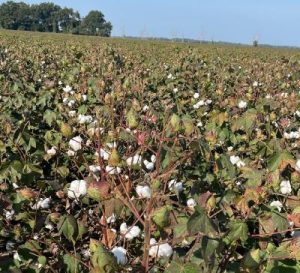
Most of August was very hot and dry in most parts of North Carolina. Rain has been infrequent and sporadic, although some areas may have received enough rain throughout the period or were, at least, less impacted by drought. Hot and dry weather typically causes several potential upper young bolls to shed, and the plant will temporarily cease blooming altogether, especially if there is a heavy boll load. In most areas, this is a very common scenario. This typically accelerates crop maturity, as the remaining bolls are relatively larger and more mature than normal at this point. Similarly, there was more April-planted cotton this year than normal. Boll opening began during the last week of August and will become more prevalent in the coming weeks. As of right now, the forecast appears to be relatively warm with low but sporadic chances of rain over the next couple of weeks. Why is any of this important? This impacts us in a couple of ways: the crop is or will likely be ready for defoliation noticeably earlier than normal, and we should be ready to address regrowth. In some cases, the crop is ready to be defoliated now, but only thorough evaluation of the unopened bolls will dictate when defoliation can begin.
Defoliation Timing
Typically, a crop that has reached 60% opened bolls and 4 nodes above cracked boll can be defoliated. The big underlying assumption with these rules of thumb is that the unopened bolls are mature enough that they will safely open if defoliation were to occur. However, there are exceptions to these rules, where the unopened bolls are not quite mature enough for defoliation, and we see them nearly every year. The safest way to determine if boll maturity is ready for defoliation is to slice the uppermost harvestable bolls and evaluate the seed and lint inside. Once the seed are well developed and start forming a distinct and darker seed coat, defoliation can occur without compromising the opening of these bolls. Such bolls should be difficult to slice, and lint should string out when doing so.
Defoliation Timeliness (Different from Defoliation Timing)
With regard to “timeliness” of defoliation, this is an area that we could probably improve upon. In some years, the crop is ready before we are, and this year will likely be one of those years. In the peanut-producing areas of the state, naturally those growers will focus their attention on peanuts first and deal with cotton later. However, with baler pickers, we have the opportunity to address both in a timely manner. There have been years in the past when cotton could’ve been defoliated much earlier than it was. Likewise, harvest could’ve been conducted earlier. In some cases, defoliation was delayed until late September or early October, due to attention diverted to peanuts or simply because we were prepared for harvest. In some of those instances, tropical or otherwise adverse weather (cloudy, cooler, wet weather that caused hardlocking, etc.) took away some yield potential or degraded quality, whereas an earlier harvest could’ve preserved that yield potential, had we defoliated as soon as the crop was ready.
DON’T defoliate more than you can effectively harvest 2 to 2.5 weeks later. It does no good in terms of yield or quality to leave cotton fully exposed longer than necessary. The quality of any given boll will be the best that it’ll be the day it opens. Beyond that point, quality can remain the same or decline. The more weather it encounters, the more rapidly and severely it will decline. The same applies to yield contribution of any given boll. The more rain or wind that an open boll encounters, the more likely lint will be lost or lose weight. Defoliating as soon as fields are ready, and continuing defoliation in a sequence that follows crop maturity, allows for timely harvest to follow. This rule should be followed until mid October, which is discussed below.
Try to get as much done in October as possible. For several years, we have said that it pays less and less to delay defoliation beyond mid-October. Recent research has clearly confirmed that. Usually, we don’t accumulate many more meaningful heat units beyond mid-October in most years; therefore, waiting on bolls to mature beyond mid-October will require a noticeably longer time, and they still may not open. Recent research has clearly illustrated that it is better to defoliate by mid-October, which allows a couple of weeks of time and the last remaining heat units before our average first frost date (late October through early November), which therefore allows our boll openers to perform.
Read more defoliation tips and strategies, including tankmix considerations, here.




Leave a Reply