

In early November, five Extension cotton specialists from North Carolina to Arizona joined Cotton Grower to take a look back at what happened in 2007, then ahead to what 2008 could bring.
The five will be featured on a panel at the Beltwide Cotton Conferences in Nashville on the morning of January 10.
They are:
- Dr. Keith Edmisten, Professor and Extension Cotton Specialist, North Carolina.
- Dr. Joel Faircloth, Cotton/Peanut Specialist, Virginia.
- Dr. Chris Main, Cotton and Small Grains Production Specialist, Tennessee.
- Dr. Robert Lemon, Extension Agronomist – Cotton, Texas
- Dr. Randy Norton, Extension Cotton Specialist, Arizona.
One of the main topics for panelists will be the spread of glyphosate resistance, especially in Palmer amaranth.
“It’s important to have a resistance management plan,” says Dr. Bill Robertson, the National Cotton Council’s manager, Agronomy, Soils and Physiology. Robertson serves as the coordinator of the Beltwide’s Cotton Production programming. “Glyphosate is not the only chemistry we’re having resistance to. I know cotton specialists get together a good bit as a group, and we’re putting together some uniform studies from across the Belt, looking for some of the answers growers have questions about.”
The Big Question Mark
If you ask, “How was your cotton crop this year?” the number of answers would be equal to the number of people you ask.
A severe drought hammered much of the Southeast. For the Mid-South, great cotton in one field could turn to a plant-bug disaster in another. In Texas, some areas got more rainfall in two months than they normally get in a year. There was less heat stress in Arizona, and it actually rained a time or two.
“Dry weather was certainly the overwhelming theme,” says Edmisten. “I don’t know how much we are below average, but it’s 20-something inches.” That was the case in South Carolina and Georgia. In fact, Georgia Governor Sonny Perdue called for a “Day of Prayer” in early November.
“This was probably one of the best early seasons we’ve had since I’ve been here,” Faircloth says. “But that changed very quickly. … It turned out better than we though it would, but the crop was hurt by dry weather.”
“West Tennessee is still 14-20 inches below normal rainfall,” adds Main. “It’s pretty much the same for the Missouri Bootheel, north Alabama and north Mississippi.”
Of Arizona, Norton says, “It was a good year. We had minimal heat stress compared to previous years, and early reports are coming in that yields are very good.”
The U.S. is projected to make a little more than 17 million bales this season.
But That Was Then, This is Now
What Will 2008 Bring? With the possible exceptions of Georgia and Texas, cotton acreage will be down. Early predictions are that 10 million acres will be on the high side.
But there will be many other questions to cover in 2008, like varieties, traits, the new module-building pickers, and weed and insect resistance, just to name a few.
ARIZONA
Dr. Randy Norton
THEN: “I think we are going to do pretty well in Arizona (in 2007). Yields were up and costs were significantly lower than they have been in recent memory. By and large, they are a happy group.”
NOW: “One of the big issues for 2008 will be planting varieties that are well adapted to growing conditions in Arizona. They aren’t all necessarily bred for Arizona.
“People are worried about labor. We have three of the new (module-building) pickers in the state, and there is a lot of interest in that to help with the labor burden.”
VIRGINIA
Dr. Joel Faircloth
THEN: “One thing that got us was nitrogen cost. Prices for the whole Belt were out the roof, and it changed the dynamics of cotton production, and certainly corn production.”
NOW: “Our growers are definitely aware of (weed resistance). It’s brought up at every meeting we have, but that doesn’t always mean something is being done about it. The ones that have it are serious about it. We have people from Georgia and South Carolina coming to our meetings to let our people know just how serious it is.”
TENNESSEE
Dr. Chris Main
THEN: “We’ve got a resistant horseweed problem and our guys did a good job of getting that under control. We’ve been using residuals for three years now, so our guys are very familiar with using a residual product.
“We have farmers who learned that there is a reason why they grow corn in some areas, and in some areas they don’t.”
NOW: “For us, (the new module-building pickers) are the wave of the future because of our labor concerns. We will have both (the Case IH and John Deere) at our cotton meeting in February.
TEXA
Dr. Robert Lemon
THEN: “In the south Texas region, we had more rain than we could utilize. That set us back. Most of our crop was 3-5 weeks late, depending on what the conditions were, but it was all late, no matter what. … On the High Plains, Mother Nature was kind to us and we are going to make another bumper crop.”
NOW: “When I talk to growers, the first thing they want to talk about is varieties. We have a lot of growers who want to make the switch to a Roundup Ready/Bollgard II variety, and they are asking which is the best. Variety selection is what you are going to have to work with all year, and it has to pay the bills.”
NORTH CAROLINA
Dr. Keith Edmisten
THEN: “Our main problem was dry weather, and probably second would be resistant Palmer amaranth. We are going to turn to a lot more alternative chemistry, adding residuals like Cotoran — things we have gotten away from.
NOW: “You used to be able to plant your whole farm in one variety, but today it’s important to plant more than one or two because it helps spread the risk. With the new varieties coming, it’s important that growers are exposed to them as quickly as possible on limited acreage.”
Captions:
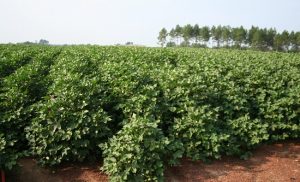
Glyphosate-resistant Palmer amaranth is spreading.
Dr. Bill Robertson
Brad Thompson
Deere Model 7760 module-building cotton picker
The Case IH Module Express 625
also add photos for Arizona, Virginia, Tennessee, Texas, North Carolina
Add chart:
Average Farmer Prices (in dollars per ton)
Source: USDA




Leave a Reply