

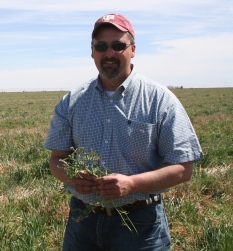
Located squarely on the High Plains of West Texas, the town of Hale Center poses the same set of agronomic challenges that growers in the rest of the region face. Days are hot while nights can get cold during the growing season. Strong winds can cause damage to a young crop. Most notably, droughts can wreak havoc in any given year in this notoriously dry part of the country.
But a shared set of challenges can elicit some unique solutions in the growing community. And in talking with Hale Center producer Bobby Byrd, it doesn’t take long to realize he’s just the type of grower who will experiment with different production practices.
Byrd’s 1,800 acre farm features some unusual cover crops, progressive no-till and minimal-till practices, and the occasional CAP trial from Bayer CropScience to get a first-hand look at varieties the company could introduce in the future. The grower is quick to point out, though, that he is very selective about which new agronomic practices and products he’s willing to try.
“Nobody has it all figured out, and that definitely includes me,” Byrd says. “The way my mind works, I look at something and say, ‘What’s the risk on this, or what’s the return on this?’
“And I’m not normally the first person to jump out and use new technology. I may use something new this year and not next year, but that’s because in my mind I’ve worked out what’s the risk and what’s the return. I heavily evaluate everything I’m going to try,” Byrd says.
Those evaluations are made from a well-educated viewpoint. Byrd graduated from Texas A&M with a master’s degree in agronomy. When asked about any given plant on his farm, he’s likely to answer in terms of biological processes and genetic make-up. The knowledge he acquired and the contacts he made while in school are still having an impact on his farm.
Unusual Cover
A discussion with a friend in USDA offices in Temple, TX, led Byrd to plant a highly unique cover crop – hairy vetch – on his operation two years ago. The idea was to plant a legume to increase the nitrogen in his soil, as well as to provide a heavy cover in certain fields that suffered from weed problems. He says that decision is still paying dividends.
“They grow a lot of hairy vetch up in Oklahoma behind wheat. We were talking about it and I looked into it, and nitrogen at the time was over a dollar a pound. I said, ‘If I can find a way to fit that in, maybe behind my corn where I get my corn out early, and cut my nitrogen costs and then build my soil at the same time, that might be something I want to look into,’” Byrd says.
He let the vetch grow throughout the year and didn’t cut it until the following May, when he planted cotton in the same field. After growing a healthy cotton crop, Byrd tested his soil and found 80 pounds of nitrogen per acre still left in the ground for use in the coming growing season.
The nitrogen isn’t the only benefit from the hairy vetch, though. Because the plant is so thick and winter-hearty, it drowns out any weed pest that would otherwise take try to creep into a field during the late winter and early spring. Byrd says the vetch helped clean up fields that had previously been trouble spots for marestail and horseweed.
“I don’t know where all I’m going to go with this, but there is some value in it. That 80 pounds of nitrogen this year, that’s probably $65 an acre right there that’s left on that crop. As we’re getting into this deal where water’s declining, and we have to start making some decisions about maybe watering one half of a field and fallowing the other half, these cover crops may start coming more into play,” Byrd says.
On top of that, Byrd says his vetch fields drew in a multitude of wildlife from around the area, making for a pleasant scene throughout the year.
“I’m kind of weird about stuff like that, but it was really neat to see how as little as 30 acres would change an environment right there in that area,” he says.
For cover crops, Byrd says sorghum also does the trick.
“I plant my sorghum broadcast on dryland, and then chop them down where I’m going to plant cotton, and then plant into those stalks standing up. The old stalks keep the sand from blowing, and they hold a little moisture. That seems to work pretty well.”
Minimizing Tillage
Many of Byrd’s production practices are incorporated so that the grower can have a light touch on his soil. Byrd says he practices no-till “everywhere that’s possible” and minimal-till in areas where he deems it absolutely necessary. His reasoning is relatively simple.
“The first reason is that water’s expensive and I think it helps me out as far that is concerned. The second one is that labor is hard to find, and the third one is I don’t like what plowing does to the ground,” Byrd says.
“But it’s not easy. I would say no-till is nearly as expensive, if not more-so than conventional farming. You have to watch it a lot closer. It’s easier to plow than it is to do no-till. You’ve got to watch your weeds, you’ve got to watch your planter, and you’ve got to pretty much do it yourself.”
Getting Results
Like many growers in the area, Byrd had one of his best seasons ever in 2010. Unusually good soil moisture throughout the season, and timely applications of PGRs helped him achieve personal bests as far as cotton yields. Byrd credits Bayer germplasm for helping him achieve those results. In 2011, for the first time in over a decade, he will plant cotton on all 1,800 of his acres, and he plans on devoting nearly all of that ground to FiberMax varieties.
“About 3 years ago, I just started planting all FiberMax. The reason I did was because they are consistent yielders and consistent on fiber quality. They all seem to be that way. It’s not just here or there. These FiberMax varieties in my CAP trials, I’ve seen them push 4 bales an acre, and I even had one of the new ones last year, the FM 2484B2F that was close to 5 bales,” Byrd says.
In addition to the workhorse varieties that have proven successful on his farm over the years, Byrd plans on planting a Stoneville variety, ST 4288B2F this year. He will also plant another relative newcomer, FM 1845LLB2, in the coming season. Byrd says he utilizes the LibertyLink technology in fields that have traditionally been trouble spots with weeds on his operation.
This year he was inducted into the FiberMax One Ton Club, reserved for FiberMax growers who achieve 2,000 pounds per acre on their farms. Byrd credits the ideal growing conditions in 2010 as well as FiberMax germplasm for that feat.
“I don’t push for four bales every year, I don’t put out a whole bunch of fertilizer. It was just a good year, and that cotton over there just did very well,” Byrd says.


Leave a Reply