

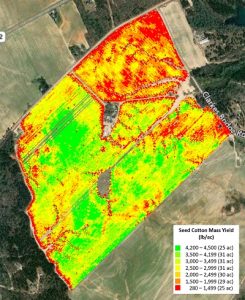
The basic idea behind the new sensor-based monitors is nothing new. The systems give growers the ability to map out their fields, taking note of differences in plant health along the way.
In a perfect world, plant height, biomass index and health would all be uniform across every field. As growers are well aware, that is rarely the case. So mapping options like aerial imagery were introduced to give growers a better idea of just how their crop is progressing, and what specific spots in a field need attention more than others. As Varco points out, growers aren’t the only ones to employ this technology.
“With NASA developed technologies, we can see the crop and infer growth from satellite imagery. Presently, there are companies that use this information to develop crop forecasts to sell to people who deal with commodity futures,” says Varco. Obviously, growers can use the sensor technology for the much more practical purpose of crop management that it was intended for, he says.
“You can use that aerial or satellite imagery, or the sensor-type data, to predict growth with a certain degree of accuracy.”
One setback with aerial imagery practices has been that growers typically wait for a day or two to receive data after the images have been captured. While seemingly minor, this pause in production can cause major troubles for growers dealing with small application windows due to the weather.
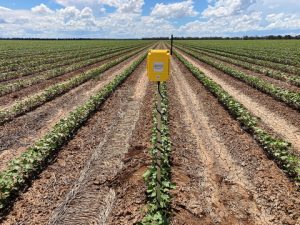
New sensors from Topcon, Trimble and Ag Leader place the monitors on the tractor, harvester or sprayer as it moves across a given field, and displays and uses that data in real-time, eliminating any pauses in production.
“I think this concept is relatively new in cotton,” says Tim East, Southeast Regional Sales Manager for Trimble. The company recently purchased and released GreenSeeker, an on-the-go system for sensor-based applications. “What makes GreenSeeker useful is that you’re able to apply anything that you want based off this data we’re able to collect. And it allows you to make these variable-rate applications on a real-time basis, which can be very important for growers,” he adds.
How They Work
Each of these three systems – Trimble’s GreenSeeker, Topcon’s CropSpec, and Ag Leader’s OptRx – operate under some of the same basic principles.
Each system features a monitor or sensor that can be applied to any tractor, harvester or sprayer. The sensors make real-time assessments of a field as they pass over it, and relay that data to applicators that are also linked into the system.
In order to collect that data, the systems use what is known as “active light” to gather information. Essentially this means that the sensors are able to gather their information through light that they project onto the plants. The sensors are not reliant on natural light from the sun, meaning that, if needed, they could be used even in the dark of night.
But what type of information are the systems collecting? According to Topcon’s Dr. Carol Snyder, sensor-based applicators can monitor a plant’s chlorophyll level, as well as its Normalized Difference Vegetative Index (NDVI).
“Our sensor, CropSpec, as well as the others can give you an indication of the amount of chlorophyll in the plant. Research has found that to be highly correlated with the nitrogen level of the plant. So then, all of us are using the same theory or concept that we’re looking at the level of chlorophyll of the plant as an indicator of plant health, and then everyone is working on algorithms to be able to understand, ‘OK, with this particular reading, I want to be able to apply this particular amount of fertilizer,’” says Snyder.
According to Varco, monitoring a crop’s NDVI level is also an important process.
“Plants, as they grow and build more and more chlorophyll, are a lot like rolling out a green carpet more and more. A crop starts as a seedling with a majority of the viewing area displaying soil, and as plants grow more leaf area is viewed. As this is occurring, we can track growth using NDVI as an indicator,” says Varco.
“We can get a good indication of the growth of the crop, as the growth stages advance. Using an indice such as NDVI, one can get a good indication of the leaf area or what’s called a biomass,” he adds. This information could prove especially useful as cotton growers decide where and when to apply plant-growth regulators during the growing season.
“If a grower walks out to his field and sees that he’s got cotton three feet tall, and also that he’s got cotton a foot and a half tall, and upon inspection internode length is excessive on the taller cotton, he can make a decision to apply growth regulator. Using one of these sensors to infer plant height and a calibration, a pgr can then be applied at varying rates according to sensor measurements, for instance,” says Varco.
In addition to pgr, defoliant and nitrogen applications, Varco says the systems can be used to do soil mapping before a crop is ever planted.
“Early in the season you can do bare-soil imagery where you’re just getting the reflectance of the soil and doing analysis for organic matter or moisture content,” he says.
Paradigm Shift
The fact that three companies are releasing these systems in relatively short order should not be lost on growers. Obviously, there is confidence that these products could have a large, positive impact on agricultural markets, cotton included.
“In my mind it’s a bit of a paradigm shift in how farmers are managing their operations,” says Topcon’s Snyder. “In the past, the general practice had been that we didn’t want nitrogen to be a limiting factor in the field. Farmers would apply fertilizer at planting, and they would put on extra to make sure they had enough throughout the growing season,” she says.
“If we put all that nitrogen on preplant and then it rains, then it runs away and we’ve lost money. So the theory is that if we can better time the application of that nitrogen to the plant throughout the growing season, put it there throughout the season specifically when and where it needs it, then we can more efficiently manage that crop,” says Snyder.
Varco echoes Snyder’s comments, saying the idea is to be as efficient as possible in crops that have variability in plant growth.
“Where you have differences in soil types and drainage and slope, and where you get differences in growth across a field, that makes it more difficult to manage it efficiently. Sensor-based applicators will give a grower the ability to adjust things based on his or her intuitive knowledge and research based knowledge,” he says.


Leave a Reply