

Precision agriculture technology has made tremendous strides in the Cotton Belt in recent years, thanks in large part to the fact that many of the technologies and techniques being employed are creating real dollar savings for cotton growers.
In 2007 and beyond, entities such as Cotton Incorporated and southern land grant universities, as well as leading precision technology manufacturers are working on developing new ideas, as well as perfecting those that have been coming of age. In this edition of Cotton Grower Plus we take a look at some of these best ideas and concepts as viewed by these front line companies and organizations.
Dr. Ed Barnes, associate director, agricultural research at Cotton Incorporated, cooperates with universities and organizations to help support projects in precision agriculture that show promise for helping U.S. cotton growers improve practices and get more efficient. Here are some of the hot button projects that Cotton Incorporated is currently working on.
Predicting Nematode Infestation
Root knot nematodes can be a significant economic problem for cotton growers, causing significant yield loss and potentially wiping out parts of fields when left unchecked. The dilemma is cost – a grower needs to spend upwards of $35 per acre to control the pest each year, making entire field applications impractical. On the other side, soil sampling to get more precise about applications costs about $25 per sample for a single nematode assay, another untenable number for the grower.
Barnes, in cooperation with Dr. Bob Nichols, also in the ag research division at Cotton Incorporated, are applying their respective expertise to solve this economic and agronomic conundrum. “Bob knows nematodes, and I know precision technologies, so it’s definitely been a cooperative effort,” notes Barnes.
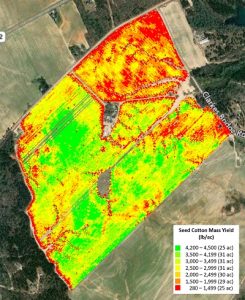
What is known about the nematode is that it favors sandy soil. So, researchers at the Louisiana State University, the University of Georgia at Tifton, and the University of Arkansas have been working to exploit this tendency using soil conductivity mapping. Soil conductivity analysis such as that generated by systems manufactured by Veris Technologies (as well as others) can, with a single pass over the field, create a soil-type map that includes an indication of sandy areas. Using the soil type map, researchers can overlay the information with a yield map or normalized difference vegetation index (NDVI) image map and line up sandy soil areas with sections of poor yield performance. “What researchers have been finding is that if you have a high sand content and low yield, and you know there is root knot nematode in the area, you can start mapping out your root knot nematode infestations with very little soil sampling,” explains Barnes. “We are still calling it research, but the results have been consistent.
“What we have now are some tools to do site-specific application of nematicides,” says Barnes. “At the sites we work in Georgia and Louisiana, and other areas as well, there is a lot of evidence that soil conductivity highly correlates to sand content.”
On The Go Sensing
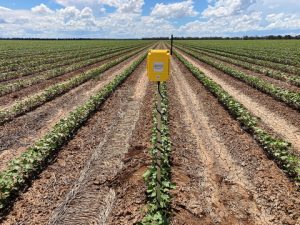
Another thing Cotton Incorporated is interested in exploring further in 2007 is potential uses for GreenSeeker on-the-go sensors. These units mount right to the front of a tractor and provide data similar to NDVI imagery taken aerially. Barnes notes that this technology opens up the possibility of sensor controlled defoliant application that’s controlled by the plant itself.
You’re not using an application map made by the computer,” explains Barnes. “You do some field calibration with the sensor, and as you drive through the field it varies the rate based on the reading it collects in real time.” Barnes doesn’t see it as competition with imagery currently provided by companies such as InTime, but as complementary to it. “There will be times that you will want to scout the field ahead of time, and times where you won’t be driving equipment through there and you will want to use an aerial image,” notes Barnes.
Some recent preliminary tests on variable rate fertility using the same technology also seem promising, he adds. “We are doing testing to look at how to do variable rate control of nitrogen using data similar to aerial imagery. InTime has a product that uses an image you take near the end of the season that would help you plan your nitrogen application for the beginning of the next season. We hope to extend this using aerial or on-the-go images to come up with a method to do variable-rate sidedress applications. The increasing cost of nitrogen, with no immediate relief in sight, is making this research important and relevant.”
Software Utility
Not truly precision technology, but still very important to the precision system, is data management and record keeping. To this end, Cotton Incorporated’s Jeanne Reeves, staff ag economist, has been doing a lot of work with record keeping software, work that was discussed at the recent Beltwide Cotton Conferences. An accounting package called Perception has been adapted for cotton and integrates accounting functions and data, with precision agriculture data through linkage with MapShots, says Barnes.
“We’re talking about the possibility for improved record keeping and better knowledge of what the crop really costs us,” he adds. “Even if we aren’t doing variable rate, if we are using the kind of equipment that can be set up to record what we have applied, it can have a lot of value for catching mistakes, or equipment failure, or just better document what happened during the year.”
Cotton Incorporated is also talking to other software manufacturers including ZedX, manufacturer of AgFleet software, and SST Software. “Both of these companies offer some unique processing capabilitieis to growers so they can do some advanced things without knowing that much about geographic information systems,” says Barnes.


Leave a Reply