

Jake Easley opened his presentation at the Beltwide Cotton Conferences in New Orleans by showing a picture of a wrench. Then he asked, “Is this a wrench or a tool?”
The question was not just rhetorical, there was an answer: “It starts as a wrench, but if you put the wrench in the hands of someone who can use it, it becomes a tool,” said Easley.
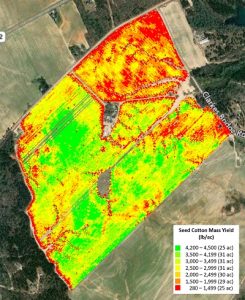
And so it goes with aerial imagery. InTime is a Cleveland, MS-based company that began by providing aerial imagery, and only aerial imagery. And that was fine as far as mid-’90s technology went.
But these days, not so much. “We changed our approach,” Easley explained. “When we started selling imagery, we were selling just that – an image. We didn’t sell a solution; we didn’t sell a product. So we rethought what we were trying to do and decided that we needed to provide information that a farmer can use. We asked ourselves, ‘Is this an image, or a tool?’”
InTime brought three additional products to the market that enhanced the established Veri-Scout. “Veri-Scout is our standard product,” said Easley. “It measures biomass. From that we came up with products that help you do a better job.”
The new products are Veri-N (for variable-rate fertilizer applications), Veri-Soil (an “intro” product for precision ag; a way to get started) and Veri-Gation (for making prescription irrigation decisions).
Veri-Gation measures plant temperatures, which gives moisture content of those plants. The higher the relative temperature of the plant, the drier the plant. From that, prescription irrigation decisions can be made.
“What we have learned in Australia is to not second guess the crop; listen to it, react to it,” said David Sloane with Adelaide-based Agrilink. “If you do this, you can make scheduling decisions.” (In Aussie-speak, it’s “shed-uling,” but the Yanks in the audience understood.)
What Agrilink discovered was that cotton growers were using too much water over the course of the season. That is a definite no-no with Australia’s water restrictions, which were stringent even before the extreme drought started in 2006. “Water is a very limiting resource in Australia,” Sloane said. “We have lots of ground; not a lot of water. We have to stretch it as far as we can.
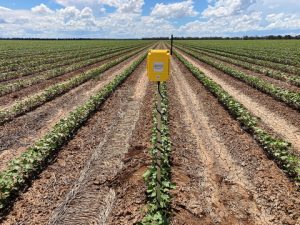
“It’s a paradox, but we discovered that the less water we used, the more cotton we made,” he added. And that would be through prescription applications of irrigation water. Agrilink makes a soil-probe system that uses sensors to measure soil moisture content. Measurements are continuous, allowing for precise applications of irrigation water on precise areas within a field.
“What we are looking for is trigger points,” Sloane said.
And there are two triggers: When to turn water on, and when to turn it off.


Leave a Reply