

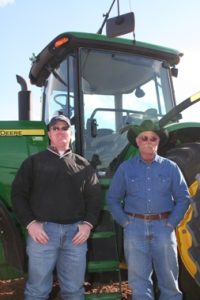
David Pearson and his father Bobby certainly aren’t the first growers on the High Plains to contend with water shortages. But the way they deal with these issues ― and their expectations despite them ― says a lot about the direction of the cotton industry in West Texas.
The Pearsons farm approximately 3,400 acres of cotton in the Lubbock and Levelland areas, roughly half of which is irrigated in some form. Of their irrigated acres, about 15% are sub-surface drip irrigation, while the rest is under pivots. But with half of their cotton dryland, and a constantly unpredictable weather pattern in the area, each year can seem like a gamble for the Pearsons.
“Our water is falling off every year. We have less and less. It’s just been in the past two years that we’ve been having to pump so much of it, because it’s been dry,” says David, stressing that last year was a particularly challenging season for his cotton.
“At our farm northwest of Levelland, we’re about 300 feet above sea level higher than our farm here (south of Levelland). Up there, we got a frost on September 22, and that’s way too early. Normally it’s 30 days later. Here, it didn’t frost, but it was still too cold, and I mean it shut the plant down,” he says.
With such disastrous conditions, most growers would be happy to have anything left to harvest. And what type of results did Pearson see on his farm ― the one that saw a dry early season and an early cold snap that shut his plants down?
“Consistently, we got about 1,500-pound yields. On this farm, we pretty much figure for every gallon a minute that it’s had, that’s how many bales it should produce. This farm here it’s been two and a half to three gallons per minute per acre, so we’ve been about 1,500 pounds on this farm,” he says.
The accomplishment of producing three-bale cotton in such a difficult year isn’t lost on Pearson. He recognizes a good thing when he sees it.
“Last year, about the top three to four bolls never presented. But what’s crazy to me is the grade was still there. We still averaged 55 cents in the loan,” he says.
Still, if he sounds just a little disappointed that his crop didn’t do better, it’s because he is. The family farmer has come to expect outstanding results through the years — despite the rough conditions.
Going to Seed
Pearson plants FM 1740B2F on much of his irrigated acreage. The early-to-medium maturity Roundup Ready Flex/ Bollgard II variety is one that he’s got high hopes for.
“On my other block of drip, (FM 1740B2F) has got four gallons of water on it, but we didn’t make four bales last year with the weather we had. This year we’ll try again for four, which is achievable,” says Pearson.
The variety has been adopted across the entire Belt, although Pearson says it’s a relative newcomer on his operation. Pearson says the variety’s consistent success on farms across the Belt gives him a lot of confidence in the seed.
“Everywhere it’s been in variety trials, its always in the top 10, and most of the time in the top five. I grew some in variety trials last year, and that’s what we look for is a variety that’ll stick and be in the top 10 no matter where it’s at,” he says.
Of course, having personal experience with a variety never hurts when it comes time to make a selection. Pearson planted FM 9160B2F and FM 9170B2F this year after seeing first-hand what the varieties could do on test plots on his operation last season. He also plans to devote some acreage to FiberMax’s FM 9058F as well as a Deltapine variety, DP 1044 B2RF.
Looking Forward,
Looking Back
The Pearsons have a GPS system on almost every piece of machinery they own. David has come to appreciate the versatility of John Deere’s Starfire iTC technology.
“When Deere came out with the GPS first, John Deere was pretty much the only machinery it would fit. I think they’ve realized that some of us don’t run just John Deere stuff. They’ve integrated it and made it better for us,” he says.
Aside from his GPS technology and progressive irrigation techniques, Pearson says the farm has been hesitant to dive into other aspects of precision ag, although he admits that fertilizer prices are causing him to take a second look at some progressive production practices.
But while the family farm looks forward to the latest production practices, they are having to revert back to some old crop protection methods in order to be proactive about glyphosate resistance. Pearson says the area is already getting its first look at weed resistance.
“Nobody has come out and said it publicly, but we’ve got glyphosate resistant marestail around. I know last year we sprayed some farms where I had 120 ounces of Roundup on them, and it didn’t even faze the marestail,” he says. “I had a guy tell me last year ‘You can set a jug of Roundup on it, and its not going to kill that weed.’”
Pearson’s answer is to get proactive, and stay vigilant.
“We’ll use a residual herbicide just for that reason, so we’re not having to spray every 10 days. I feel like that’s doing us some good,” he says.
The Pearsons are also plowing this season for the first time in a few years.
“Mainly that’s for our volunteer cotton. On our no-till ground, we run 2-4,D and Banvel in March or the first part of April, and most of the time that kills the marestail if we catch it early,” says Pearson.
Thinking Big
It’s those types of proactive production practices that have Pearson optimistic about the coming year. After making three-bale cotton in some decidedly rough growing conditions over the past two years, he is anxious to see just where his operation’s potential can take him. And pre-planting conditions in West Texas provided plenty of reason for optimism this year.
“We got probably six inches of rain this year. The last two years we’ve had zero. Six inches doesn’t sound like a lot, but it is for us out here,” he says. “We’re going to try to hit the four-bale mark everywhere we can.”


Leave a Reply